
 |
 |
 |

|

Summary
On the main page
Opiates and
love
Cocaine and
fight
Amphetamines
and flight
Nicotine and
food
Benzodiazepines
and sleep
Where in the
brain
Emotions
Decisioncenter
Pain
Learning
Reward
Behaviour
Training
Genes
Stress
Short term
effects
Long term
effects
Effects
between systems
Age and sex
Neural circuit
The following processes and phenomena were especially prominent for the respective drugs.|
Drug |
phenomenon |
proces |
|
Opiates |
craving |
learning,
binding with outside world |
|
anticipation | ||
|
euphoria;
withdrawal symptoms |
emotions | |
|
‘aging
out of addiction’ |
age-sensitivity | |
|
Nicotine |
getting
energy artificially |
messengerfunction |
|
gaining
weight when stopping |
longtermadaptation
of endocrinal systems | |
|
Cocaine Amphetamines |
genetic
differences in addiction-proneness |
influence
of genes |
|
sex
differences in addiction-proneness |
sex
differences in expression of genetic predisposition | |
|
reaction
to stress |
changes
in addiction-proneness is given to breed during
several generations | |
|
Benzodiazepines |
moment
of need for sleepingpill |
internal
clocks and
calendars |
With the different drugs all these processes play a role in different measures. The functional processes lead to the following scheme of important neural circuits. These processes do repeat themselves during the whole life in a rhythm determined by internal clocks and calendars.
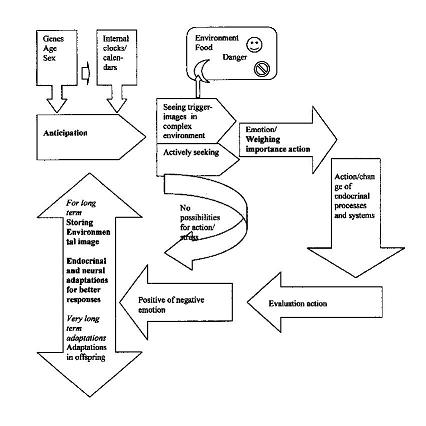 3 processes deserve
extra elucidation:
3 processes deserve
extra elucidation:1. Weighing the importance of a action in the decisioncenter. Biological research shows that a center in these brainregions weighs precisely behavioral alternatives. For example a bird weighs how much energy it costs and what is the energy-gain to go to find food.
2. Anticipation processes. Internal clocks make us anticipate on possible events, we do get hungry, we think of love and, less obvious to ourselves, we do anticipate on danger. The last asks often a lot of fysical action. Animals that have different reactions on cocaine, show permanently different behaviour. The curious one oriented on the environment knaws permanently more then the cautious other, probably in this way practising his fighting instrumentation. The anticipation does not constrain itself only to the brain, but involves a lot of other processes in the body.
3. Long and very long term processes. A lot of research is done to the relationship the development of addiction and stress. Under stress receptors do sometimes for a longer period develop themselves differently than without this type of stress would be the case. The offspring can even sometimes be influenced.
back
Drug use
But, less common, is that the substances can be taken· on the wrong moment and/or in the wrong doses
The body gets the wrong signal, for example the opiate gives the signal ‘wow, this is a nice future partner’ and forms a bond with elements from the environment, may be even a criminal setting, like someone was fallen in love. Or the body gets from nicotine the signal 'there is enough food to do energetic things', in the longer term the body get used to, what it interpretes as bigger foodsupply. Or in the case of cocaine, you don't have to do nothing to feel yourself a hero.
· puts the normal processes aside A step further is that the normal processes are replaced by the substances. There grows a bonding pure with the substance. When one misses the substance, withdrawal symptoms come up, which had the function to find a solution for the drivesystem in distress. As long as one uses the substance the system can work without the activities that belong to the system: when you take amfetamines you don't have to flight or do some other thing to feel save when you are in a stresssituation and feel unrest and anxiety. And like in sport, the body thinks that you practise fight or flightsituations and does help with muscledevelopment. It gives you the kick telling you you fight or flight well. But when you stop the body tells you that you cannot fight or flight good by yourself. And you can not give the body where it had got used to. So you get depressed by withdrawal symptoms.
· shifts between drivesystems
All the drives were during millennia necessary for one's life and for the survival of the species. Depending on the possibilities of the environment, one drive got more room in the brain and the body than the other, bonobo-monkeys spend a lot of time on love-activities and the chimps on fighting. Because the substances work like switches between systems, one system can put off another system, not permanently but temporarily. When one system is not functioning well, for example somebody lost his/her love-partner than one can suppress the sadness temporarily by eating a lot (it keeps the food system busy). Most of the times this is not functional, because we are not genetically adjusted to the long term shifting this might bring. On the long term the relationship between the systems can change.
· by people with a uncommon brain
Some people seem to benefit by specific drugs, when the regular processes don't work optimally. For example do psychoses sometimes disappear with opiates. This gives an explanation why people with an inclination for psychoses use the substances for selfmedication. Too big unrest or anxiety is fought against by ritalin, some kind of amfetamine.
back
Addiction is a longterm process
Although one can get addicted rather quickly, addiction can stay for a long time in the body. It can have the form of stimuli that provoke the desire and the emotions that go with it and/or the changed endocrinal processes. It takes time to set back these adaptations. Sometimes it can not be done even after serious tries. When regular nicotine intake has lead to the disposition to get fatter then before, then it costs some time for the body to recover. By the nicotine-use food-wanting receptors heve been formed. The experience is that it takes at least 6 months. The withdrawal symptoms of opiates, that one can compare with the first phase of lovesadness, and the following craving are big processes probably meant to bring a new adaptation. As often is the case with addictions, these processes go for the user partly on an unconscious level by adaptations of the nervous system. Every type of drug knows its own recovery period. Sometimes the body thus not find a solution; this might end in some kind of psychiatric disorder. It is obvious that in general more intensive use leads to more difficulties in stopping.back
Drugs and emotional development
For the survival of the individual and of the species are the drivesystems and the way they develop in relation to the outside world of central importance. Species have developed different systems for this that are clicked in genes. Within the species individuals develop their own variations of these systems. Every individual follows partly a fixed pattern; besides this, there can develop differences influenced by experiences and in humans the capacity to invent own conscious and unconscious variations of these systems. One sees that all systems in humans have the capacity to adapt during life. Somtimes these adaptions are given through to the offspring by the on-offsystem of our genes (epigenese). With drugs we can study these processes and wereally should do, because we get a lot of these vital substances in our bodies in uncontrolled ways. Therefore it is important to study carefully the effects on ourselves and on our offspring in every phase of development (both the different phases before and after birth).back
About the
author
Sources of
inspiration
Justification
Method
Contact